
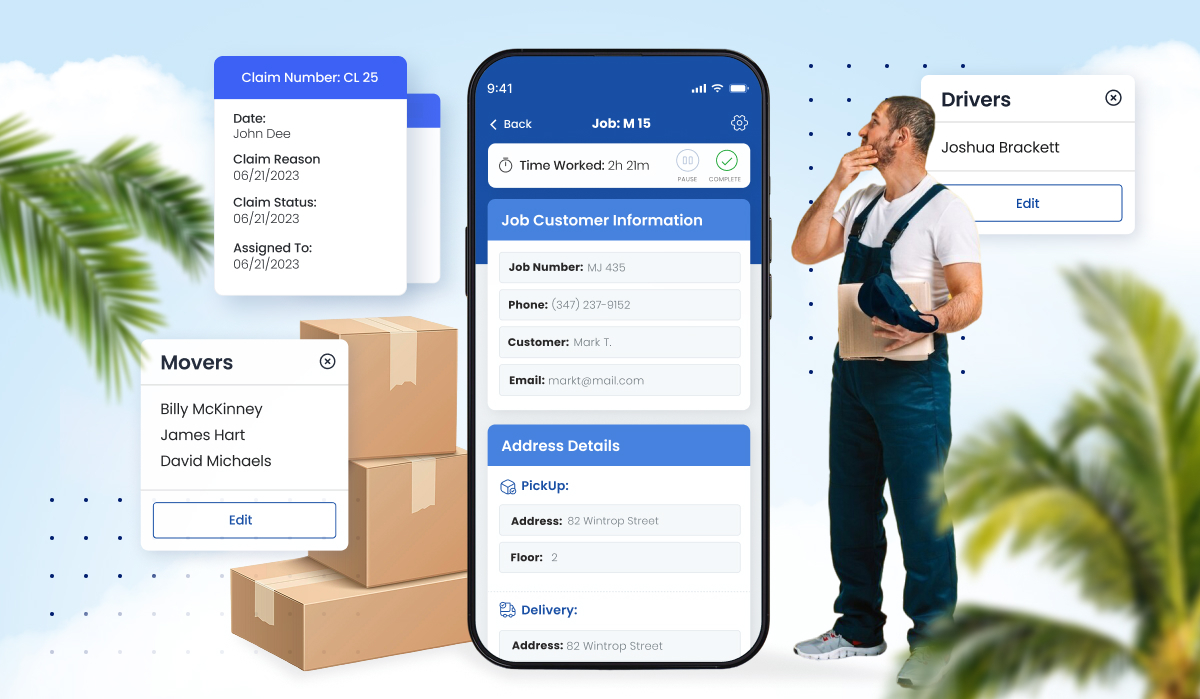
CRM implementation fails in moving companies when the system doesn’t fit moving workflows, the team isn’t prepared before launch, goals are undefined, sales reps work around it, or it’s used only for reporting. All five are avoidable.
A moving company invests in a CRM, spends weeks setting it up, trains the office staff, and expects operations to tighten up. Three months later, dispatch is still running through texts, sales reps are tracking leads in personal spreadsheets, and the billing team is manually double-checking invoices because nobody fully trusts what’s in the system.
Technically, the CRM is in use. In practice, the operation was never adopted.
This is not rare. Most CRM failures in moving companies come down to the same five problems — and none of them are about the software itself. They are about how the system was chosen, introduced, and integrated into daily operations.
The companies that make CRM work treat implementation as an operational change. The ones that fail usually repeat the same mistakes.
| Failure reason | What it looks like in practice | What needs to change |
|---|---|---|
| Wrong system for moving operations | Parallel spreadsheets, disconnected dispatch, crews working off memory | End-to-end CRM built for moving — lead to invoice in one system |
| Team not ready at launch | Inconsistent data entry, staff reverting to old methods, reports that don’t reflect reality | Structured onboarding before go-live, not a one-hour walkthrough |
| No measurable goals defined | No way to tell if the CRM is working; original problems continue unchanged | Set specific targets — response time, quote-to-book rate, billing speed — before launch |
| Sales team working around the CRM | Pipeline incomplete, leads missed, follow-up tracking unreliable | CRM must make fast response easier, not slower |
| CRM used for reporting only | Work still happening in texts, emails, spreadsheets — CRM seen as overhead | Workflows built into the system so the CRM is where work actually happens |
The CRM doesn’t match how the operation actually runs
Moving companies run on speed. Leads come in and need to be responded to immediately. Schedules shift throughout the day. Dispatch and crews need to stay aligned in real time. Billing has to close jobs cleanly after completion.
When a CRM was built for a different industry and retrofitted for moving, those workflows don’t map cleanly onto it. The system handles customer records well. But it was never designed to connect a lead inquiry directly to a job estimate, a dispatch assignment, crew scheduling, and a final invoice — all inside the same platform. What separates a moving-specific CRM from a generic one becomes clear the moment daily operations put both under pressure.
Parallel systems take over almost immediately
The office finds workarounds within the first few weeks. Estimators collect information one way, dispatch manages it another, and billing pulls from a third source. The CRM becomes one layer in a stack of tools rather than the center of operations.
The result is a company that technically has a CRM but still runs on the same combination of spreadsheets, texts, and memory it used before.
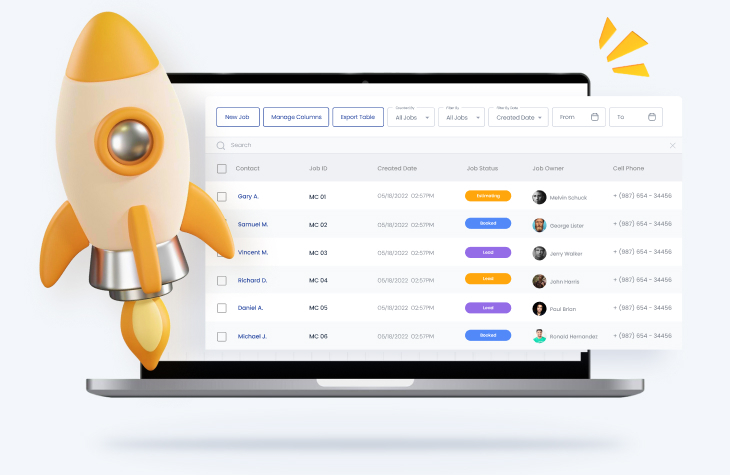
When the office and crews work from different information
This is where the damage becomes operational. The sales team updates the CRM. Dispatch works from a separate schedule. Crews rely on handwritten notes or a group chat because the latest job details never reach the system they actually use.
Information gets lost between departments. Mistakes compound during busy weeks. Management ends up reading reports that no longer reflect what is actually happening on the ground.
A CRM built specifically for moving companies removes that separation. The same system that captures the lead manages the estimate, assigns the crew, tracks the job, and generates the invoice. There is one version of the information, and everyone works from it.
The system gets launched before the team is ready
Owners and managers spend weeks evaluating CRM platforms before signing. By the time the decision is made, they understand the dashboards, the workflows, and the logic behind the system. The staff gets a walkthrough and a start date.
That gap is one of the most predictable failure points in any CRM implementation.
Incomplete training produces unreliable data
Sales reps skip fields they aren’t sure about. Dispatchers fall back on the methods they already trust because they can’t afford delays on active jobs. Billing staff keep a manual backup because they don’t yet have confidence in what the CRM holds.
Once inconsistent data is inside the system, confidence drops. Reporting becomes unreliable. Follow-ups get missed. Management loses faith in the numbers. The CRM gets blamed for not working — but the real problem was that the team was never fully prepared to use it.
Peak season makes this worse, not better
The people who depend on the CRM most are also the people with the least capacity to learn it properly during busy periods. Dispatchers are managing constant schedule changes. Sales reps are responding to incoming leads before competitors do. Office staff is processing invoices, handling claims, and managing customer communication at the same time.
Launching a CRM without proper onboarding during a high-volume period almost guarantees that teams revert to familiar methods. The timing and quality of implementation support matters as much as the system itself. Companies that underestimate this tend to run into the same issues covered in what CRM training should look like for moving companies — where adoption was never established properly from the start.
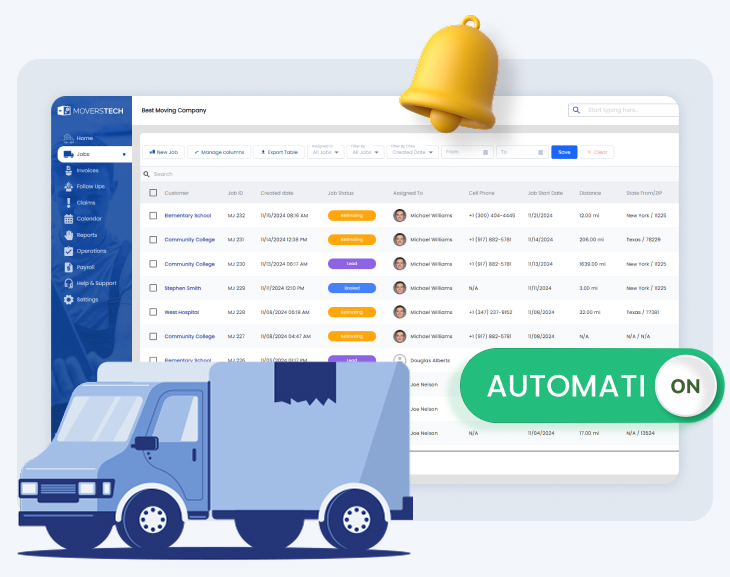
There are no clear goals for what the CRM should change
Most moving companies implement a CRM with a general sense of what they want to improve. They want better organization. Fewer things falling through the cracks. Everything in one place. Those are reasonable frustrations — but they are not operational goals.
Without benchmarks, there is no way to measure progress
If a moving company cannot define what success looks like before go-live, it also cannot tell whether the CRM is actually working three months later. The system runs. Numbers appear in the dashboards. But the original problems — slow lead response, missed follow-ups, billing errors — continue at the same rate because nobody set a target for them.
Successful implementations start with specific, measurable problems: lead response time needs to drop below a defined threshold, invoices need to be sent within a set number of hours after job completion, and every dispatched job needs a confirmed crew assignment inside the system before the truck leaves.
When those benchmarks are in place before launch, it becomes possible to track whether implementation is delivering results or whether something needs to be adjusted.
Peak season hides operational gaps — until it ends
High call volume creates the impression that everything is working because revenue is still coming in. Inefficiencies stay invisible when phones are ringing. The same company that felt in control during June is looking at missed bookings and billing discrepancies in October.
The right time to define CRM goals and review operational readiness is before peak demand, not during it. That is exactly the purpose of a structured pre-season reality check — identifying gaps while there is still time to close them.
The sales team works around the CRM instead of through it
Moving leads are time-sensitive. A customer requesting a quote is usually contacting several companies at the same time. The first to respond with a clear, accurate estimate wins the booking in most cases. Speed is not a competitive advantage — it is a baseline requirement.

When the CRM slows down response time, the team stops using it
If following the CRM workflow requires more steps than a sales rep’s personal system, the CRM loses. Lead information gets copy-pasted from multiple sources. Customer details get re-entered manually. Follow-ups get tracked in a separate spreadsheet because the CRM process takes longer than a quick note in a personal document.
Once that happens, the pipeline inside the CRM no longer reflects what is actually happening. Ownership of leads becomes unclear. Multiple reps contact the same customer. Managers cannot get an accurate read on conversion performance because the data they’re looking at is incomplete.
Disconnected lead handling quietly drains revenue
Leads that don’t get a fast, organized follow-up don’t convert. That revenue doesn’t show up as a line item anywhere — it simply doesn’t appear. The cost is invisible until someone compares lead volume against booked jobs and notices the gap has been widening for months.
The issue is rarely effort. Most sales teams in moving companies are working hard. The problem is that the lead sources movers spend on most heavily require speed and consistency to convert — and a CRM that adds friction to the response process makes both harder. The marketing budget keeps going out. Conversion rate quietly drops. Nobody connects the two until the numbers become hard to ignore.
A CRM that reduces the time between a lead coming in and a rep making contact isn’t a nice feature — it’s the difference between winning and losing jobs that were already within reach.
The CRM is treated as a reporting tool instead of an operational one
Some moving companies implement a CRM primarily so management can view dashboards and weekly summaries. The actual work — dispatch, billing, crew communication, follow-ups — still happens outside the system.
This is one of the most common ways a CRM investment produces no operational change.
A reporting layer on top of existing workflows changes nothing
When teams see the CRM as an administrative task rather than a tool that makes their job easier, data gets entered after the fact — inconsistently, partially, and often inaccurately. Dispatch uses a separate scheduling board. Billing runs through spreadsheets. Customer communication happens through email chains that nobody else can see.
The reports look like they contain useful data. But the underlying operations haven’t changed. The same inefficiencies exist — they’re just accompanied by a dashboard now.
The CRM has to be where work happens, not where it gets summarised
A successful implementation changes how daily work gets done. Dispatch happens inside the CRM. Crews get assigned through it. Invoices are generated from the job record. Follow-ups are tracked there because that is where the pipeline lives.
That shift matters especially for moving companies managing multiple crews across high job volume. When the CRM is the operational center rather than a reporting add-on, the data is accurate because it reflects real activity — and automation starts to compound those gains over time.
The difference between a CRM that gets used and one that gets worked around is almost always about how deeply it is embedded into daily workflows. That is why the automation blueprint for movers and an honest look at barriers to CRM success are useful starting points for any moving company evaluating whether their current setup is actually working.
What a successful CRM implementation looks like
The moving companies that get lasting value from a CRM share a few things in common. They chose a system built for moving operations — not adapted from another industry. They treated go-live as the beginning of an operational transition, not the end of a software purchase. They defined measurable goals before launch, prepared the full team with structured onboarding, and built their daily workflows into the system rather than around it.
When all five of those conditions are in place, a CRM stops being something the team tolerates and becomes something the operation depends on.
If you want to see what that looks like for a moving company at your scale, schedule a private demo and walk through how MoversTech fits your existing workflows.
Frequently Asked Questions
What are the most common reasons CRM implementation fails for moving companies?

Most failures come down to five problems: the CRM wasn't built for moving operations, the team wasn't properly prepared before launch, there were no measurable goals set in advance, the sales team found it faster to work around the system than through it, and the CRM was used only for reporting instead of running daily operations.
Why do moving companies struggle with CRM adoption more than other businesses?
Moving operations depend on speed and real-time coordination across sales, dispatch, crews, and billing. When a CRM adds steps instead of removing them — or when information lives in multiple places — teams default to whatever gets the job done fastest. That's usually texts, spreadsheets, and memory rather than the CRM.
How do you know if your CRM implementation has failed?
The clearest signs are parallel systems running alongside the CRM — dispatch happening through texts, leads tracked in personal spreadsheets, billing double-checked manually. If the team is working around the system rather than through it, implementation hasn't fully taken hold regardless of what the dashboards show.
